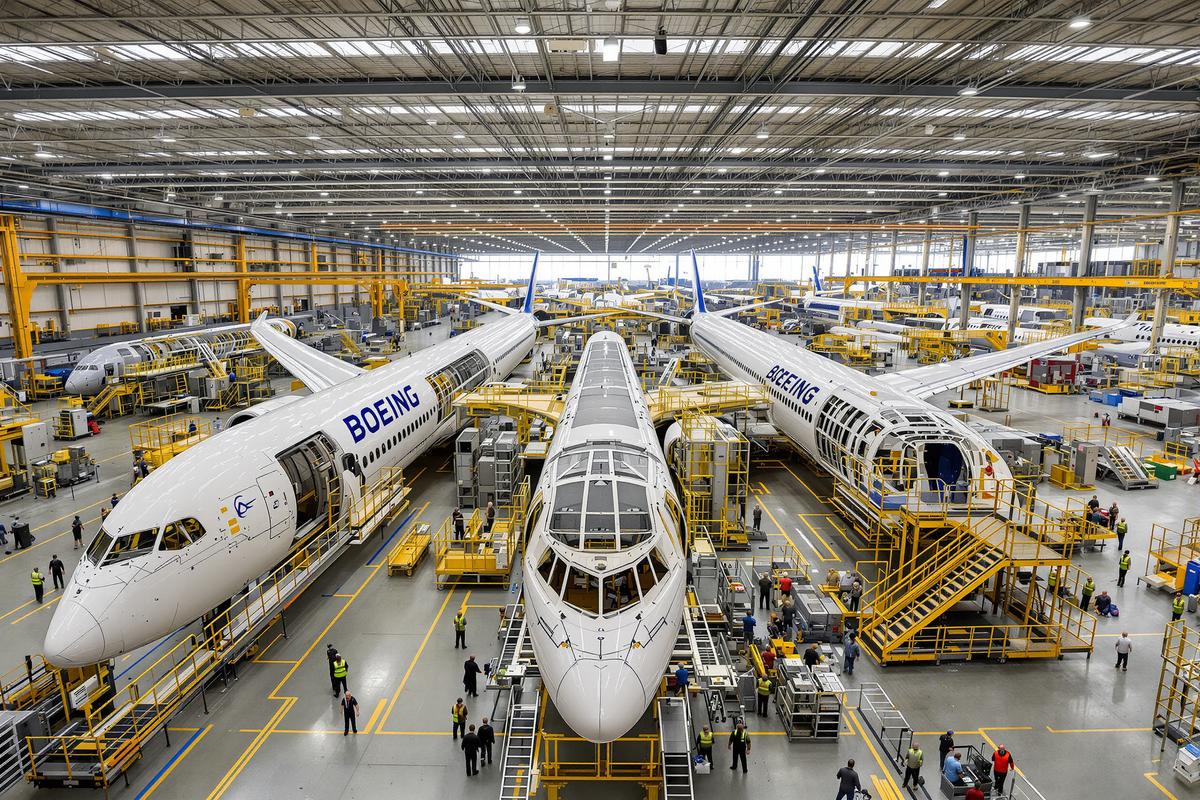
Behind massive steel doors in Washington state, a staggering industrial giant hums with precision. It’s the world’s largest factory by volume, and inside, something mind-blowing happens every single day—up to eight aircraft are assembled at the same time. All of it powered by a human force of over 30,000 workers.
If that sounds like something from a science fiction movie, you’re not alone. But this isn’t fiction. It’s a masterclass in engineering, teamwork, and scaling production to an epic level most people can’t even imagine.
Where is the world’s largest factory?
You’ll find this mega-factory in Everett, Washington, just north of Seattle. It’s where Boeing, one of the biggest names in aviation, assembles its wide-body jets. And calling it “large” barely does it justice.
The numbers tell the real story:
- 472 million cubic feet of space
- Buildings span over 98 acres of floor area
- Over 26 football fields could fit inside
Even the workers move around using bicycles and scooters. That’s how massive it is. When a storm hits outside, clouds literally form near the ceiling. It’s so big, it once had its own weather system.
How do they build eight jets at once?
At any given time, multiple aircraft are in different stages of completion. This isn’t guesswork—it’s a finely tuned ballet of machines, manpower, and flow control. The main jets built here include:
- Boeing 747 (now retired)
- 787 Dreamliner
- 767
- 777
Each jet requires hundreds of thousands of parts, and every component must arrive on time. Workers aren’t just building planes—they’re working inside a perfectly choreographed system of timing and space-use.
What do 30,000 workers actually do?
This industrial army is divided across countless roles. It’s not just engineers and mechanics. The workforce includes:
- Design teams who refine aircraft models
- Supply chain experts who coordinate parts from around the world
- Assembly line workers installing everything from wings to seatbelts
- Inspectors and testers checking every bolt and circuit
No part moves forward without checks. Every screw, wire, sensor and panel goes through multiple layers of certification and testing. It’s a high-stakes environment, because one aircraft error can cost lives or billions in damages.
Just how fast is plane production here?
The production rate depends on demand and complexity, but consider this: a 787 Dreamliner, one of the most advanced commercial jets, can be completed in as little as two weeks once assembly begins. That’s due to the streamlined process of:
- Pre-assembled parts arriving just in time (JIT manufacturing)
- Automated technologies speeding up repetitive tasks
- Round-the-clock shifts coordinating every stage
Imagine building a flying machine the size of a skyscraper in just days. That’s what happens here—even while eight planes are being assembled at once.
What makes this factory unique?
Lots of facilities build aircraft. But Everett stands apart because of its scale, complexity, and human coordination. Few places in the world can:
- Build multiple jets of different models at the same time
- House 30,000+ people on-site each day
- Wrap all this into a flow that delivers flights safely, consistently, and fast
It’s not only about size. It’s about what that size enables—speed, flexibility, and innovation. Over five decades, this factory has delivered over 7,000 aircraft to airlines in almost every corner of the globe.
Is this the future of aerospace?
Maybe. But things are changing. Boeing has shifted some Dreamliner production to its South Carolina plant. Automation continues to evolve. New environmental rules push factories to become smaller, leaner, more sustainable.
Still, the Everett facility remains a beacon. It shows what humans and machines can achieve—at scale, with discipline—when every person understands their role in building something that flies.
Final thoughts
Standing inside the world’s largest building, watching planes take shape like puzzle pieces coming together, is a reminder of what’s possible. It’s more than steel, panels, and rivets. It’s about coordination, ambition, and trust.
And with eight aircraft in motion at the same time, it’s proof that even the sky might not be the limit.