
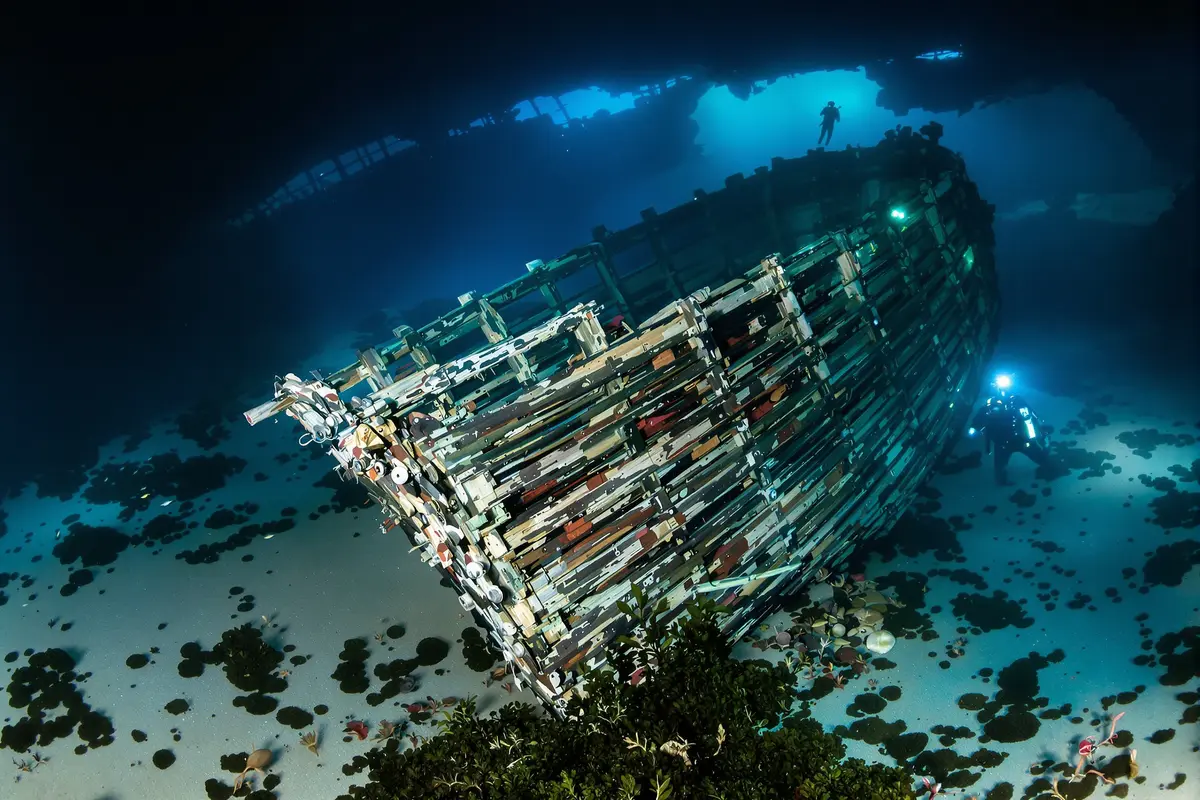
It started with a shadow beneath the waves—nothing unusual at first. But as the divers drifted closer, lights cutting through the murk, what they saw didn’t fit the usual script. A long spine of timber. Iron bolts still solid in place. Not driftwood. Not debris. A whole ship, frozen in time for 250 years.
Now, experts are calling it one of the most extraordinary maritime finds in Australian waters. An age-old vessel, nearly untouched by time, waiting patiently beneath the sea.
A 250-Year Secret, Finally Surfaced
The wreck was found off a quiet stretch of Australia’s coastline, an area not known for historic shipwrecks. The discovery stunned researchers. What they saw below the surface wasn’t ruins—it was a ship preserved so well, you’d think the crew just stepped off yesterday.
This wasn’t just any ship. It appears to be the lost vessel of an 18th-century European explorer, missing for 250 years. Historians debated its fate for decades. Some doubted it ever sailed. Others thought it was just misfiled in old records. But sonar scans revealed its resting place. And a team of archaeologists soon confirmed: it’s no ghost story.
An Underwater Time Machine
Sunken ships don’t usually last this long. Currents, storms, marine life—they all chew through wood and metal. But not here. Something unusual happened. The cold, low-oxygen waters acted like a vault.
- Timbers remain locked tight by original iron bolts
- Cargo layout still matches 18th-century ship manifests
- Even ropes and barrel hoops lie in place, untouched
The hull’s features help pinpoint its origin: British construction, armed for exploration but designed for long sea journeys. Artifacts on board—pewter plates, a glass bottle, rusted tools—are the kind of humble clues archaeologists love. Not treasure. Not gold. Just traces of real life at sea.
How Scientists “Read” a Ship Without Touching It
Finding a ship like this is rare. Preserving it is even harder. The team follows a strict process designed to protect the site from harm—accidental or otherwise.
- Step 1: Document Everything – Divers take videos, photos, and 3D scans before moving anything.
- Step 2: Stabilize the Site – They secure timbers and protect the wreck from currents or future anchor damage.
- Step 3: Lift With Caution – Only objects at risk are removed for conservation.
- Step 4: Long-Term Care – Artefacts are slowly desalinated, cleaned, and studied over years.
- Step 5: Share the Story – Research findings aren’t locked away; they’re published and even turned into digital reconstructions.
It’s a delicate balance. One wrong move can scatter centuries of clues. That’s why archaeologists often say: “You don’t plunder the past—you listen to it.”
Why This Discovery Hits So Deep
Scroll through online reactions, and it’s easy to see why people connect with this find. There’s a quiet poetry in a wooden ship, lost for centuries, suddenly speaking again.
On a planet moving at full speed, the idea of something staying still for two and a half centuries stirs something in us. This vessel, caught in a peaceful pocket of ocean, didn’t sink into silence. It waited.
But not everyone sees the past in the same light. For Indigenous communities whose histories intersect with European arrival, this wreck carries a heavier meaning. It’s a symbol of both scientific wonder and cultural disruption—a reminder that exploration brought maps, but also loss.
What Happens Next?
This is only the beginning of what may take decades to fully explore and understand. Here’s what we know and what’s ahead:
- Public access: The site’s exact location remains secret to prevent looting. Virtual tours are in the works.
- Full ship recovery? It’s unlikely. Raising the entire hull could destroy it.
- Identification: Experts are confident about the ship’s identity but await further testing—like timber dating and archival comparisons.
- Findings so far: Common tools, dining ware, scientific instruments—clues to daily shipboard life in the late 1700s.
- Long-term research: Every nail and plank tells a story. Uncovering them takes years of careful work.
A Window to the Past That Still Speaks
This isn’t just a shipwreck. It’s a rare link between memory and matter, history and saltwater. In its silence, it speaks of ambition, survival, routine, and unplanned endings. And its discovery reminds us of one powerful truth:
Sometimes the past is closer than we think—we just weren’t looking in the right place.